





Breaking News |
- World Wide
- International
- National
- State
- Union Territory
- Capital
- Social
- Political
- Legal
- Finance
- Education
- Medical
- Science & Tech.
- Information & Tech.
- Agriculture
- Industry
- Corporate
- Business
- Career
- Govt. Policy & Programme
- Health
- Sports
- Festival & Astrology
- Crime
- Men
- Women
- Outfit
- Jewellery
- Cosmetics
- Make-Up
- Romance
- Arts & Culture
- Glamour
- Film
- Fashion
- Review
- Satire
- Award
- Recipe
- Food Court
- Wild Life
- Advice

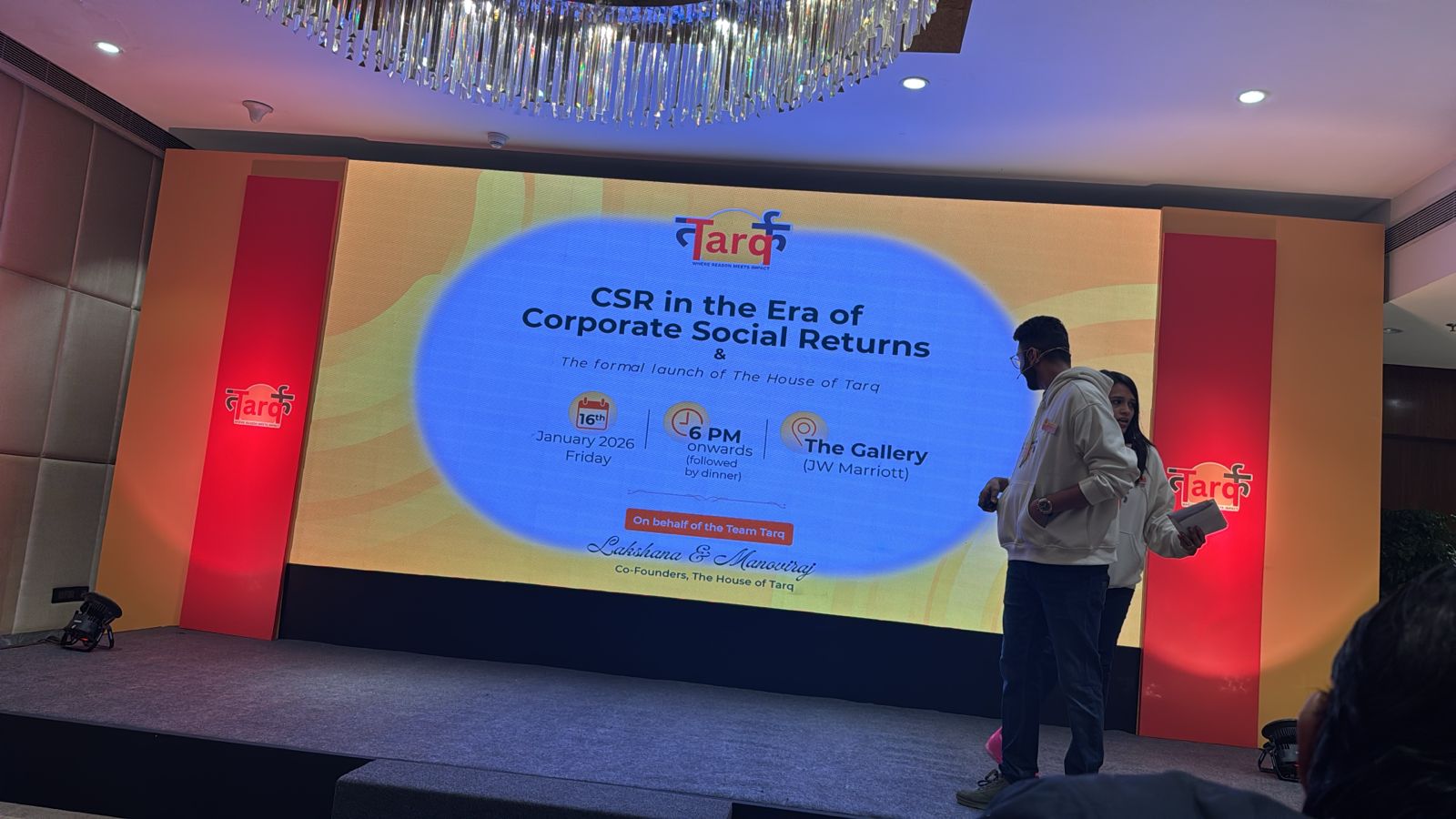
House of Tarq Launches, Marking the Next Phase of India’s CSR Ecosystem
New Delhi-
As India’s CSR ecosystem enters a more mature phase, the challenge before organisations is increasingly one of design rather than intent. Programmes today operate across corporate priorities, government frameworks, and community realities—requiring leadership that understands how these systems intersect in practice.
The launch of the House of Tarq brings together two founders whose careers have unfolded across exactly these intersections. Manoviraj Singh and Lakshana Asthana, Co-Founders of House of Tarq, have spent over a decade working at the heart of India’s CSR and development ecosystem shaping programmes, building partnerships, and navigating the operational realities of large-scale social investment across sectors. Their work has consistently involved translating corporate intent into programmes that function within public systems, while remaining responsive to on-ground conditions. This exposure has informed the philosophy behind House of Tarq: that CSR succeeds not when individual components perform well in isolation, but when strategy, execution, and communication are designed to work together as a system.
House of Tarq reflects this belief. Conceived as India’s first Corporate Social Returns’ Architects, the institution approaches CSR through a lens that recognises the interdependence of business objectives, governance structures, and community outcomes - bringing coherence to how responsibility is designed and delivered.
“Much of our experience has been at the points where good intent meets operational complexity,” said Lakshana Asthana. “We’ve seen how programmes can weaken when design and execution aren’t aligned. House of Tarq has been built to address that gap—by treating CSR as a system that must function across stakeholders, not just within organisations.”
Manoviraj Singh added, “Across our work, one pattern has been clear: impact that isn’t clearly strategised, executed, or articulated often fails to build trust over time and gets institutionally forgotten. Corporate Social Returns is our way of ensuring that outcomes are not only delivered, but also understood, validated, and carried forward across cycles.”
As India’s CSR ecosystem enters a phase marked by greater scale, regulatory maturity, and rising expectations around outcomes, the emphasis is increasingly shifting towards how programmes are designed to function over time and across institutions. In this context, approaches that bring together strategic intent, execution realities, and clarity of communication are becoming more relevant.
The House of Tarq takes shape within this landscape, shaped by founders whose work has consistently engaged with CSR at the intersection of business priorities, public systems, and community realities, and informed by the belief that responsibility delivers lasting value when it is designed to hold together across these dimensions.


संबंधित पोस्ट




Follow Us On


Subscibe Latest News
SUBSCRIBE US TO GET NEWS IN MAILBOX
Image Gallery

Video Gallery


लाइव क्रिकेट स्कोर
शेअर मार्केट
टैग

 कॉपीराइट सुरक्षित: इस वेबसाइट के सभी लेख DMCA कॉपीराइट प्रोटेक्टेड हैं। कॉपी या किसी भी रूप में किसी भी सामग्री का उपयोग करना एक गंभीर अपराध है।
रिपोर्टर
The Reporter specializes in covering a news beat, produces daily news for Aaple Rajya News
Dr. Rajesh Kumar