





Breaking News |
- World Wide
- International
- National
- State
- Union Territory
- Capital
- Social
- Political
- Legal
- Finance
- Education
- Medical
- Science & Tech.
- Information & Tech.
- Agriculture
- Industry
- Corporate
- Business
- Career
- Govt. Policy & Programme
- Health
- Sports
- Festival & Astrology
- Crime
- Men
- Women
- Outfit
- Jewellery
- Cosmetics
- Make-Up
- Romance
- Arts & Culture
- Glamour
- Film
- Fashion
- Review
- Satire
- Award
- Recipe
- Food Court
- Wild Life
- Advice

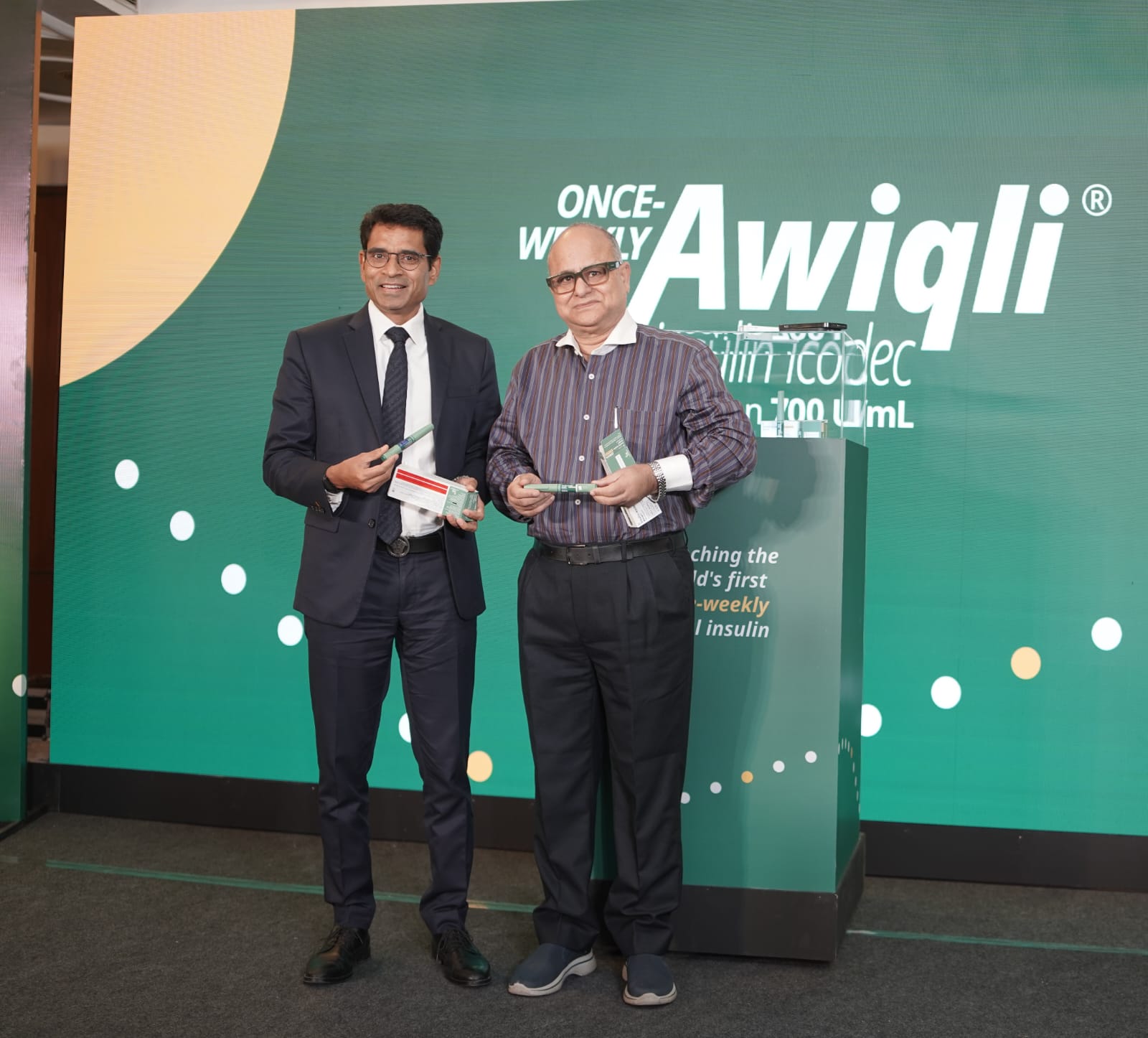
Awiqli® (insulin icodec): Novo Nordisk India launches World’s First Once-Weekly Basal Insulin
From daily injection to just once a week, Novo Nordisk sets a new standard of convenience in diabetes care
* First and only once-weekly basal insulin — a global innovation in diabetes therapy1
* Reduces injection burden significantly, from 7 injections per week to just 1; expected to ease injection barrier, especially in India where insulin is delayed by ~7-9 years
* Backed by a robust clinical trial program, including Indian population, which showed superior HbA1c reduction, better time in range vs. currently available insulins, without compromising on safety
* Delivered via Novo Nordisk’s FlexTouch® device, known for ease and precision globally
* Reinforces Novo Nordisk’s 100+ years of commitment to advancing diabetes care
9 July 2026, New Delhi: Novo Nordisk India today announced the launch of Awiqli® (insulin icodec) in India — the world’s first once-weekly basal insulin, for adults with Type 1 or Type 2 diabetes mellitus. Awiqli® is set to fundamentally transform the insulin regimen for people with diabetes - from a once-daily routine to a once-weekly injection, thereby reducing the annual injection burden from 365 to just 52. This is not just an incremental update — it is a fundamental reimagination of how insulin fits into people’s lives.
In the ONWARDS-1 clinical programme, Awiqli® achieved superior HbA1c reduction and time in range compared with once-daily glargine U100. More people with type 2 diabetes reached an HbA1c below 7% without hypoglycaemia. Time in Range — an increasingly important complement to HbA1c — was also significantly increased with Awiqli®, giving patients better control through the day.2
Vikrant Shrotriya, Managing Director, Novo Nordisk India, said: “The launch of Awiqli® is a defining moment for diabetes care in India. For more than a century, Novo Nordisk has pursued one ambition: to make insulin therapy simpler, safer and more accessible for patients. Once-weekly dosing has long been an aspiration in our field. Today, it is a reality for India. We believe Awiqli® will reduce the psychological and physical barriers to insulin initiation — and ultimately help more people achieve better control and a better quality of life.”
Dr SK Wangnoo, Senior Consultant Endocrinologist and Diabetologist, Apollo Centre for Obesity, Diabetes & Endocrinology (ACODE), Indraprastha Apollo Hospitals, New Delhi said: “Insulin remains the cornerstone of diabetes management for many patients, yet delayed initiation and non-adherence continue to undermine outcomes in clinical practice. Innovations that meaningfully simplify the treatment experience have the potential to change patient behaviour. A once-weekly basal insulin could reduce the apprehension around starting insulin and help clinicians have more productive conversations about timely treatment.”
India’s Diabetes Landscape: An Urgent Call for Solutions
India is at the epicentre of the global diabetes epidemic. The scale of the problem — and the barriers to managing it — make Awiqli®’s arrival particularly timely.
* Over 101 million people in India live with diabetes - one of the highest burdens globally.3
* An additional 136 million have prediabetes - representing a massive population at risk.3
* The NFHS-6 (2023-24) survey confirms a sharp rise in blood sugar levels across both urban and rural India5:
– 20.9% of men aged 15+ have high blood sugar or are on diabetes medication - up from 15.6% during NFHS-5 (2019-21)
– 17.8% of women aged 15+ have high blood sugar or are on medication - up from 13.5% during NFHS-5 (2019-21)
* Insulin initiation in India is delayed by 7–9 years on average, driven by fear of injections, anticipation of pain, and cost concerns.³
The barriers to insulin therapy in India span both patient and physician perspectives:
* Patient-side: fear of injections, anticipated pain, cost sensitivity, treatment complexity
* Physician-side: risk of adverse effects (hypoglycaemia, weight gain), complex titration regimens, and concerns about patient adherence
As type 2 diabetes progresses, insulin therapy becomes clinically necessary — yet the perceived burden of daily injections creates resistance. Awiqli® directly addresses this resistance. With once-weekly dosing, robust clinical evidence, and the convenience of Novo Nordisk’s FlexTouch’s® device, Awiqli® has the potential to change the conversation around insulin — from one of avoidance to one of confidence.
About Awiqli®
Awiqli® (insulin icodec) injection 700 units/mL is a prescription medicine and the first and only once-weekly basal insulin approved for adults with Type 1 and Type 2 diabetes mellitus.3,4 Designed as an alternative to daily basal insulin, its approval is supported by the ONWARDS clinical programme6-11 — a series of six phase 3a trials across diverse adult populations living with Type 1 and Type 2 diabetes mellitus. Awiqli® is administered once weekly on the same day each week, using the Awiqli® FlexTouch® pen.¹ Awiqli® is currently approved in the US, entire EU, and 13 additional countries.
About the ONWARDS Clinical Programme
The ONWARDS programme comprises six phase 3a global clinical trials, including a trial with real-world elements, involving more than 4,000 adults with type 1 or type 2 diabetes, including Indian patients.5 All six trials met their primary endpoints.6-11
About Novo Nordisk India Pvt. Ltd.
Novo Nordisk India was established in 1994 with its headquarters in Bengaluru, Karnataka. The company serves as the India affiliate of Novo Nordisk A/S- a leading global healthcare company, founded in 1923 and headquartered in Denmark.
With a heritage of more than 100 years in diabetes care, our purpose is to drive change to defeat serious chronic diseases — from diabetes and obesity to rare blood and endocrine disorders — by pioneering scientific breakthroughs, expanding access to medicines, and working to prevent and ultimately cure disease. We are committed to long-term, responsible business practices that deliver financial, social and environmental value.
Novo Nordisk employs about 67,900 people in 80 countries and markets its products in around 170 countries.


संबंधित पोस्ट




Follow Us On


Subscibe Latest News
SUBSCRIBE US TO GET NEWS IN MAILBOX
Image Gallery

Video Gallery


लाइव क्रिकेट स्कोर
शेअर मार्केट
टैग

 कॉपीराइट सुरक्षित: इस वेबसाइट के सभी लेख DMCA कॉपीराइट प्रोटेक्टेड हैं। कॉपी या किसी भी रूप में किसी भी सामग्री का उपयोग करना एक गंभीर अपराध है।
रिपोर्टर
The Reporter specializes in covering a news beat, produces daily news for Aaple Rajya News
Dr. Rajesh Kumar